If you are choosing between MBR and MBBR, the short answer is simple. MBR gives the cleanest treated water in the smallest space, while MBBR offers lower cost and easier operation. Ultimately, the right choice depends on what will be done with the treated water.
What is an MBR system?
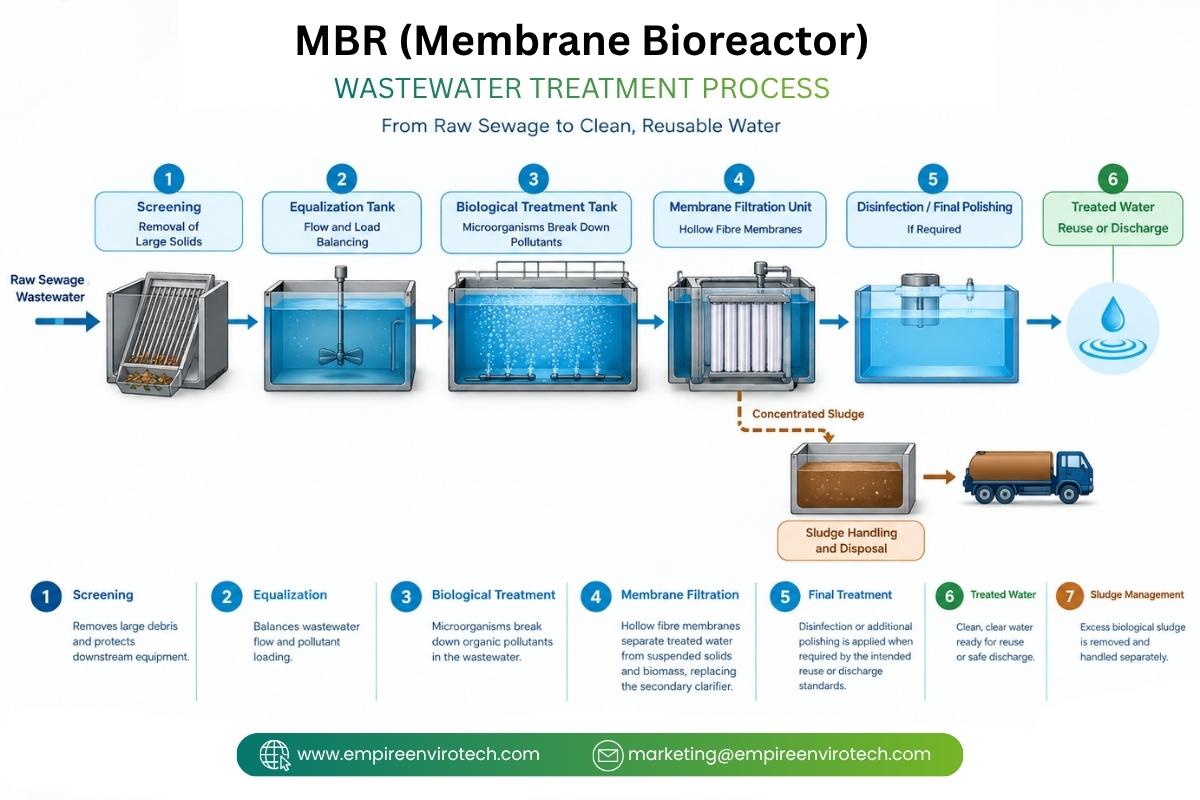
A Membrane Bioreactor, or MBR, combines a biological tank with membrane filtration. Microorganisms break down the pollution first. Then, hollow fiber membranes separate the clean water from the sludge. Because the membrane acts as a physical barrier, a secondary clarifier is not needed. As a result, the treated effluent achieves very low turbidity and TSS. However, direct reuse suitability depends on the target application—while it is readily fit for secondary uses like toilet flushing, landscaping, or cooling towers, high-grade industrial applications still require site-specific polishing such as RO or disinfection.
What is an MBBR system?
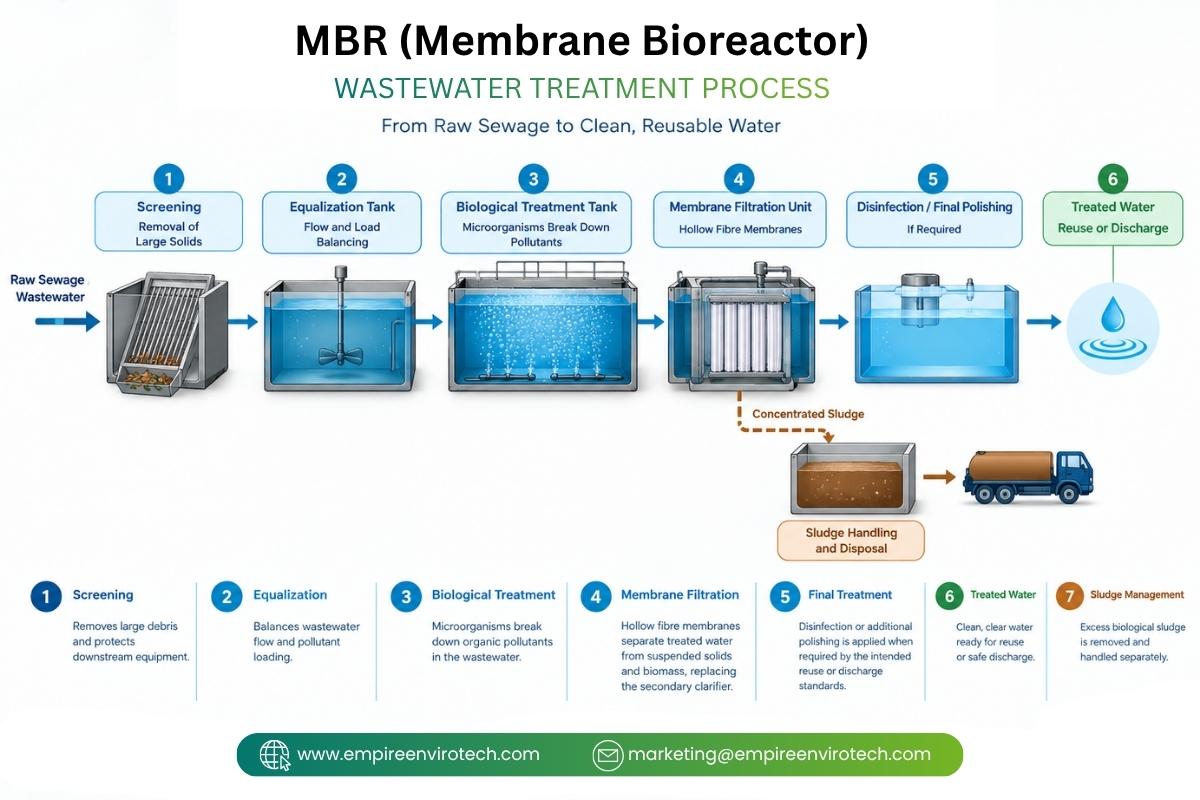
A Moving Bed Biofilm Reactor, or MBBR, works differently. Small plastic carriers float inside the aeration tank, and a biofilm grows on their surface. Air keeps the carriers moving, so the biomass stays active. However, a clarifier is still needed afterward to settle the solids. With appropriate secondary clarification and downstream tertiary treatment (such as media filtration or disinfection), MBBR can also achieve high-quality effluent suitable for discharge or select reuse, while keeping the design simple, forgiving, and resilient to shock loads.
MBR vs MBBR at a glance
| Factor | MBR | MBBR |
|---|---|---|
| Treated water quality | Very high, reuse ready | Good, may need polishing |
| Footprint | Very compact | Compact, but a clarifier is needed |
| Capital cost | Higher | Lower |
| Energy use | Higher | Lower |
| Operation | Needs skilled care | Simple and stable |
| Load changes | Moderate tolerance | Handled well |
What do recent studies say?
A comparison published by Fluor in October 2025 describes MBBR as an efficient, economical option with low energy use, while MBR is credited with the higher effluent quality.
The market is also moving. According to BCC Research, the global MBR market is expected to grow from 4.4 billion dollars in 2025 to 9.4 billion dollars by 2030, with water scarcity named as one driver.
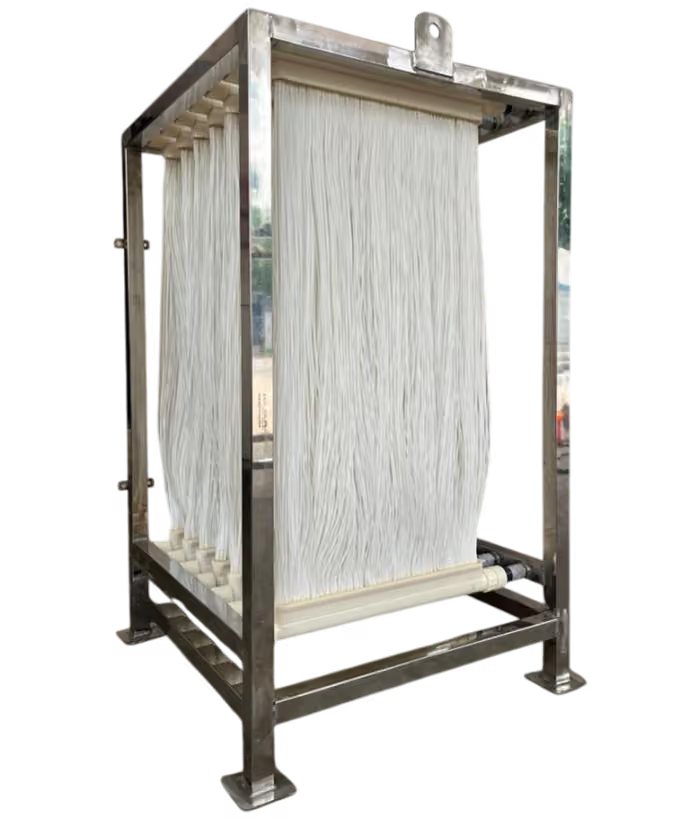
Hollow Fibre Membrane
When does MBR make more sense?
In my view, MBR is worth the extra investment in three situations. First, land is limited, as in a city or inside a factory campus. Second, the treated water will be recycled for flushing, cooling towers, or gardening. Third, discharge norms are strict.
That said, membranes need regular cleaning, and fouling must be watched closely. Therefore, a trained operator matters as much as the equipment itself.
When is MBBR the better choice?
MBBR suits sites where inflow changes often, budgets are tight, or operators are few. Moreover, existing tanks can often be upgraded by adding carriers, which reduces civil work. For plants that only need to meet standard discharge limits, this is usually the practical route.
Personally, I feel MBR is sometimes overspecified because it sounds advanced. Choosing by reuse goal and budget works better than choosing by trend.
Our experience at Empire Enviro Tech
At Empire Enviro Tech, we supply hollow fiber MBR membranes along with screens, diffusers, clarifiers, and complete treatment plants. Our team has delivered projects such as the Sewage Treatment Plant for UP Jal Board, the Sewage Treatment Plant for Vantara, and the ETP for Varun Beverage.
Every site has its own water quality and reuse needs. For that reason, we never begin with a fixed technology. We begin with the data. You can explore our membrane products or contact our team for advice.
Frequently Asked Questions - FAQ
Which is cheaper, MBR or MBBR?
MBBR usually costs less to build and run, since it needs no membranes or scouring air. MBR has higher capital and replacement costs, but it can pay off where land is scarce or high-grade treated water is reused on-site.
MBBR usually costs less to build and run, since it needs no membranes or scouring air. MBR has higher capital and replacement costs, but it can pay off where land is scarce or high-grade treated water is reused on-site.
Does MBBR need a clarifier?
Yes. Settling is required after the reactor. In MBR, the membranes take over that job.
Yes. Settling is required after the reactor. In MBR, the membranes take over that job.
Can MBR water be reused directly?
Often yes, for non-potable applications such as toilet flushing, landscaping, and cooling tower make-up. However, final reuse quality depends heavily on incoming wastewater characteristics and plant design; sensitive industrial processes may require further tertiary polishing such as RO or disinfection, and local regulatory discharge/reuse norms must always be verified.
Often yes, for non-potable applications such as toilet flushing, landscaping, and cooling tower make-up. However, final reuse quality depends heavily on incoming wastewater characteristics and plant design; sensitive industrial processes may require further tertiary polishing such as RO or disinfection, and local regulatory discharge/reuse norms must always be verified.
Can MBR and MBBR be combined?
Yes. Hybrid designs exist, and they are considered when both a compact layout and strong load handling are needed.
Yes. Hybrid designs exist, and they are considered when both a compact layout and strong load handling are needed.