Sooner or later, every industrial plant has to answer an awkward question: where does the wastewater go? Discharge permits are getting tighter, and fresh water is harder to find. Because of this, zero liquid discharge, or ZLD, now comes up in boardroom discussions.
A quick disclosure: we design and supply effluent treatment equipment, so I do have a point of view. Still, I have tried to describe the costs and limits of ZLD as plainly as its benefits. In this blog, I will cover the main benefits, the drawbacks, and a practical way to judge whether it fits your plant.
What Is Zero Liquid Discharge?
ZLD is a wastewater approach in which no liquid leaves the facility. The water is recovered and reused, while the dissolved solids end up as solid residue or salt.
A typical system works in stages. Pretreatment first removes solids, oil, hardness, and organics. Membranes, usually ultrafiltration followed by reverse osmosis, then recover most of the water. Finally, the concentrated reject goes to evaporators and a crystallizer or dryer, which turns the remaining salts into a solid.
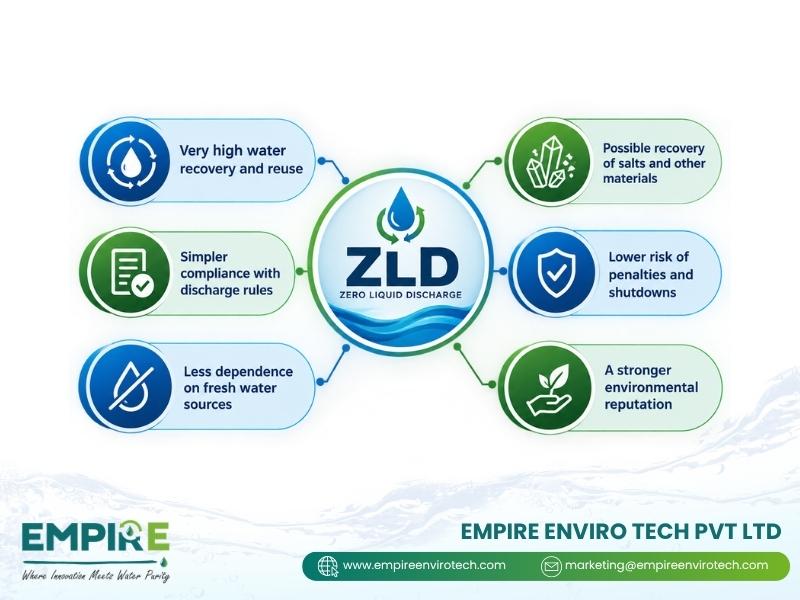
Benefits of ZLD at a Glance
- Very high water recovery and reuse
- Simpler compliance with discharge rules
- Less dependence on fresh water sources
- Possible recovery of salts and other materials
- Lower risk of penalties and shutdowns
- A stronger environmental reputation
The Benefits Explained
1. Water gets recovered and reused. Instead of sending treated effluent to a drain or river, the plant returns almost all of it to the process. Recovery of 95 percent or more is often quoted, although the real figure depends on the effluent and the design. The recovered water usually serves cooling towers, washing, and other utility needs.
2. Compliance becomes simpler. When nothing leaves the site, there is very little to measure against a discharge permit. In my experience, this peace of mind is underrated. Audits feel far calmer when the outlet pipe is effectively closed.
3. Dependence on fresh water drops. Water scarcity is a business risk, not only an environmental one. A plant that reuses most of its water is hit less when borewells dry up, or tanker prices rise.
4. Salts and materials can be recovered. A 2025 review in Nature Reviews Clean Technology notes that ZLD and minimal liquid discharge are being applied in desalination, energy, mining and semiconductor industries. It adds that resource recovery can partly offset the cost, but only when it fits the treatment train economically and within regulations.
5. Legal risk falls. Closure notices and fines can stop production for weeks. Removing liquid discharge removes the most common trigger.
6. Your reputation improves. Customers, investors, and nearby communities increasingly ask how a factory handles its water. “No effluent leaves the site” is a strong answer.
The Drawbacks You Should Know About
ZLD is not a free lunch. The same Nature Reviews Clean Technology paper describes it as expensive and energy-intensive, mainly because of evaporation and crystallization. Newer designs are helping, though. A 2025 study in Water Conservation Science and Engineering simulated closed-circuit reverse osmosis ahead of the thermal stages. It found energy use and operating costs fell by roughly 61 percent compared with a conventional setup. Simulations deserve caution, but the direction is encouraging.
Three mistakes cause most of the trouble in my view:
- Weak pretreatment. Hardness and silica scale the membranes and evaporators, and costs climb quietly.
- No plan for the salt. Mixed salts can be hard to sell or dispose of, so settle the route early.
- Sizing without lab data. An evaporator sized for the wrong salinity wastes money every month.
When ZLD Is Not the Right Choice
I would be cautious if your effluent has low salinity, your regulator does not require ZLD, and steam or power is expensive. In that case, minimal liquid discharge is a sensible middle path. It recovers most of the water at a lower cost, but a small brine stream still needs disposal. Researchers say the best design depends on location and regulations, and I agree.
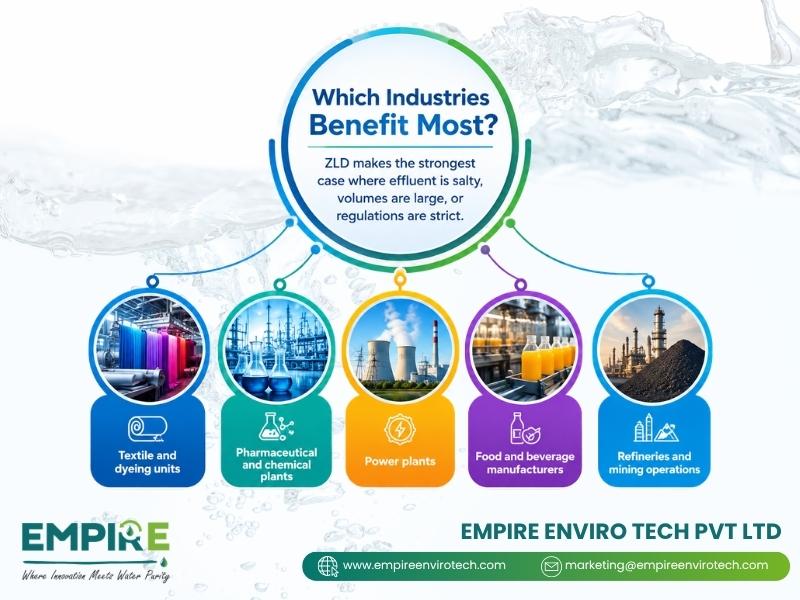
Which Industries Benefit Most?
ZLD makes the strongest case where effluent is salty, volumes are large, or regulations are strict:
ZLD makes the strongest case where effluent is salty, volumes are large, or regulations are strict:
- Textile and dyeing units
- Pharmaceutical and chemical plants
- Power plants
- Food and beverage manufacturers
- Refineries and mining operations
You can explore the sectors we serve on our industries page. One example is our ETP Plant for Varun Beverage, where dependable effluent treatment forms the base of any water reuse plan.
Where Empire Enviro Tech Fits In
A ZLD system is only as good as the stages before it. Our membranes, tertiary treatment, and sludge treatment equipment, including screw presses, support both the early and final stages of an effluent plant designed for reuse.
How to Decide if ZLD Is Right for You
1. Ask about requirements. Find out whether your regulator or location requires ZLD now, or is likely to soon.
2. Know your water numbers. Measure how much water you use and what it costs.
3. Test your effluent. Ask the lab for TDS, hardness, silica, and COD, since these decide the technology and the budget.
After that, compare full ZLD with minimal liquid discharge on lifetime cost, not purchase price alone.
1. Ask about requirements. Find out whether your regulator or location requires ZLD now, or is likely to soon.
2. Know your water numbers. Measure how much water you use and what it costs.
3. Test your effluent. Ask the lab for TDS, hardness, silica, and COD, since these decide the technology and the budget.
After that, compare full ZLD with minimal liquid discharge on lifetime cost, not purchase price alone.
Market Snapshot
Global Market Insights estimated the ZLD systems market at USD 6.8 billion in 2025, growing to USD 13 billion by 2035. Other research firms publish different numbers, so treat any single figure as a rough guide.
Frequently Asked Questions
What are the main benefits of zero liquid discharge?
High water recovery, simpler compliance, lower demand for fresh water, possible salt recovery, and reduced environmental risk.
High water recovery, simpler compliance, lower demand for fresh water, possible salt recovery, and reduced environmental risk.
Is zero liquid discharge expensive?
Yes, it usually needs more capital and energy than conventional treatment. Reused water and recovered materials can offset part of that cost over time.
Yes, it usually needs more capital and energy than conventional treatment. Reused water and recovered materials can offset part of that cost over time.
What is the difference between ZLD and minimal liquid discharge?
ZLD sends no liquid out of the plant. Minimal liquid discharge recovers most of the water but leaves a small brine stream.
ZLD sends no liquid out of the plant. Minimal liquid discharge recovers most of the water but leaves a small brine stream.
Which technologies are used in a ZLD plant?
Pretreatment, reverse osmosis, brine concentrators, evaporators and crystallizers are the common building blocks.
Pretreatment, reverse osmosis, brine concentrators, evaporators and crystallizers are the common building blocks.
Can small and medium plants use ZLD?
Yes, particularly with modular designs. A feasibility study should come first.
Yes, particularly with modular designs. A feasibility study should come first.
Is ZLD mandatory in India?
Only for certain sectors and locations. Check with your State Pollution Control Board.
Only for certain sectors and locations. Check with your State Pollution Control Board.
The benefits of zero liquid discharge are real, but so is the price tag, so the decision deserves proper homework. If you are planning an effluent upgrade and want a practical opinion, contact Empire Enviro Tech at marketing@empireenvirotech.com, and our team will help you look at the options.